
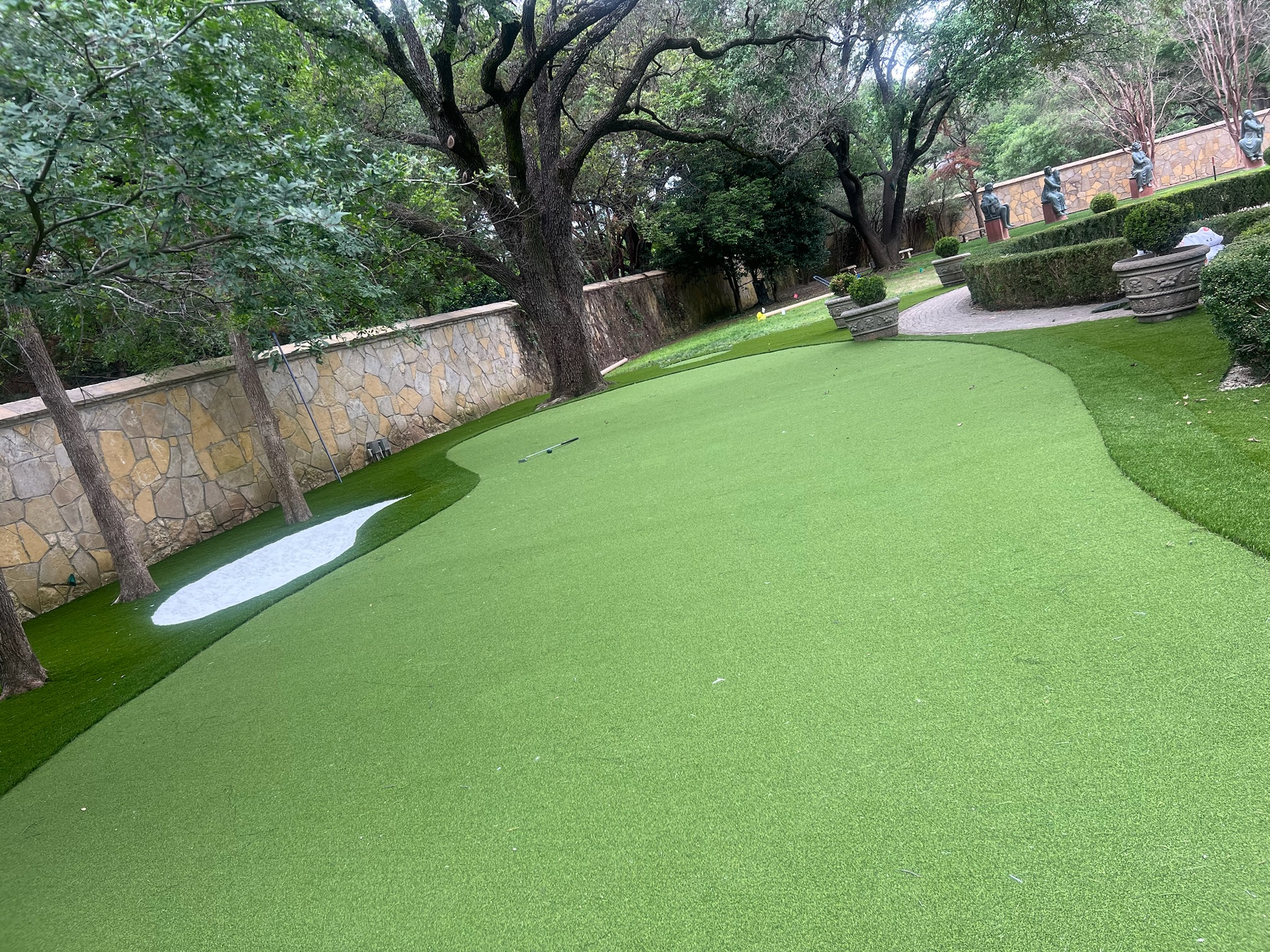
Professional Putting Green Installation in Fort Worth
Building a putting green in Tarrant County is not the same as building one anywhere else. Fort Worth sits on heavy clay soil that expands when wet and contracts during summer droughts, creating unique engineering challenges that demand local expertise. The Tour Greens Fort Worth installation crew manages every phase of construction, from initial soil assessment and grading through drainage engineering, aggregate base compaction, precision turf seaming, and final Stimpmeter calibration, so your green performs flawlessly through triple-digit heat, winter freezes, and everything in between. Whether your property is in Westover Hills, Rivercrest, or a new development along the Chisholm Trail corridor, our team knows Fort Worth ground conditions intimately and builds accordingly.

Why Fort Worth Installations Require Specialized Knowledge
The DFW Metroplex presents a combination of environmental factors that directly affect putting green longevity and performance. Fort Worth receives an average of 37 inches of rain annually, often delivered in heavy spring thunderstorms that can dump several inches in a single afternoon. Pair that rainfall with the expansive Eagle Ford clay that dominates much of western Tarrant County, and you have a recipe for shifting, settling, and drainage failure if the base is not engineered correctly.
Our Fort Worth installation team addresses these challenges head-on. We begin every project with a thorough site evaluation that includes soil composition analysis, slope measurement, and water flow mapping. From there, we design a sub-base system with proper depth and drainage pitch to handle even the most intense North Texas downpours while preventing the heaving and cracking that plague installations built on improperly prepared clay soils.
Summer temperatures in Fort Worth regularly exceed 100 degrees Fahrenheit from June through September. Our turf selection and infill formulations are specifically chosen to resist thermal degradation and minimize surface heat, ensuring your green remains playable and comfortable even during the peak of a Tarrant County summer. We also factor in the occasional hard freeze that can arrive as late as March, using flexible adhesives and expansion-tolerant seaming techniques that prevent cold-weather damage.
Why Choose Tour Greens Fort Worth for Your Installation
Selecting the right installer is the single most important decision you will make when investing in a synthetic putting green. The difference between a green that performs like Augusta National and one that develops wrinkles, puddles, or dead spots within two years comes down to the quality of the installation process.

Fort Worth Soil Expertise
We understand Tarrant County clay, caliche layers, and drainage patterns. Every base we build accounts for the specific soil conditions on your property, preventing the shifting and settling that ruins poorly planned installations.

Heat-Resistant Materials
Our turf fibers and proprietary RQS infill system are formulated to withstand sustained temperatures above 100 degrees. Your green will not fade, warp, or develop hot spots during the brutal Fort Worth summer months.
Comprehensive Warranty
Every Tour Greens Fort Worth installation comes backed by our industry-leading warranty covering both materials and workmanship. We stand behind every green we build across the entire DFW Metroplex.
The Tour Greens Fort Worth Installation Process
Our proven ten-step process has been refined through hundreds of installations across North Texas. Each phase builds upon the last to create a putting surface that delivers championship-level performance for years to come.
Step 1
On-Site Assessment and Measurement
Our Fort Worth project manager visits your property to take precise measurements, evaluate existing drainage patterns, assess soil conditions, and identify the optimal placement for your green. We map out where chipping mats, sand traps, and fringe will go while accounting for mature tree root systems and existing hardscape. Properties in neighborhoods like Mira Vista, Montserrat, and Ridglea often have unique topography that requires creative design solutions, and this is where our local experience pays dividends.

Step 2
Site Clearing and Excavation
We remove existing sod, vegetation, and any organic material from the installation area. In Fort Worth, this step is critical because the heavy clay beneath the topsoil must be exposed and evaluated before base work begins. We also excavate bunker areas, apply professional-grade weed barriers, and ensure the subgrade is clear of roots and debris that could compromise the finished surface over time.

Step 3
Base Construction and Contouring
This is where Fort Worth installations diverge significantly from projects in other regions. We build a multi-layer aggregate base using crushed limestone and decomposed granite, compacted in lifts with plate compactors and rollers to achieve the density needed to resist clay movement. Our crew sculpts the contours, breaks, and undulations that give your green its character, all while maintaining precise drainage grades that channel water away from the playing surface and your home’s foundation.

Step 4
Shock Pad and Underlayment
For short game greens and par 3 target greens, we install a specialized foam underlayment that enables the surface to realistically receive approach shots. This pad absorbs impact energy so that well-struck chips and pitches check up naturally, just as they would on a manicured bent grass green at Colonial Country Club down the road. The pad thickness is calibrated based on the types of shots the green is designed to receive.

Step 5
Turf Installation and Seaming
Our experienced turf installation team carefully rolls out the Tour Greens synthetic turf, adhering it to the prepared base with industrial-strength adhesives selected for North Texas temperature extremes. Every seam is hand-stitched and glued to create invisible joints. We align the turf grain in a consistent direction across the entire surface, which is essential for achieving the true, predictable ball roll that separates a Tour Greens installation from lesser alternatives.

Step 6
Fringe Integration
A putting green without proper fringe looks artificial and unfinished. Our installers cut, shape, and glue multiple types of fringe turf around the perimeter of your green, creating the visual transition between the fast putting surface and the surrounding landscape. This fringe also serves a functional purpose, providing a realistic chipping surface for those delicate bump-and-run shots that every Fort Worth golfer needs in their arsenal.

Step 7
RQS Infill Application
We spread our proprietary RQS-2000 infill across the putting surface in carefully measured quantities. This infill is the secret ingredient that gives Tour Greens surfaces their distinctive soft feel and stable performance. It locks the turf fibers in place, adds weight to prevent shifting during high winds common in the Fort Worth prairie landscape, and contributes to the natural ball response that makes our greens feel like the real thing.

Step 8
Power Brushing
Using commercial power brooms, we work the infill deep into the turf backing and encourage the synthetic fibers to stand upright in their natural orientation. This brushing process is performed in multiple passes from different directions to ensure uniform fiber distribution. The result is a surface with consistent density across every square inch, eliminating thin spots or uneven areas that would affect ball roll and putting accuracy.

Step 9
Proprietary Top Dressing
The finishing touch that sets Tour Greens apart from every competitor is our RQS Top Dressing, a proprietary blend of colored acrylic-coated quartz particles. This top dressing gives your green the deep, rich luster of a professionally maintained natural grass surface. It also fine-tunes the surface texture, filling microscopic gaps between fibers to create the smooth, consistent roll that makes practicing on your Tour Greens surface genuinely productive.

Step 10
Speed Calibration and Final Walkthrough
Every Tour Greens Fort Worth installation concludes with precision speed calibration. We use heavy rollers to dial the green to your preferred Stimpmeter reading, whether you want to match the moderate pace of your Saturday morning foursome at Shady Oaks or replicate the lightning-fast surfaces found on the PGA Tour. We walk you through the finished green, explain basic maintenance procedures, and make sure every detail meets your expectations before we consider the project complete.

Built for the Fort Worth Climate
Fort Worth presents a unique combination of climate challenges that directly impact putting green construction and long-term performance. Our installation methodology has been refined specifically for these conditions.
Drainage Engineering for North Texas Storms
The DFW Metroplex is prone to severe thunderstorms that can deliver two or three inches of rain in under an hour. A putting green with inadequate drainage will puddle, erode its base material, and develop soft spots that ruin the playing surface. Our Fort Worth installation team engineers drainage into every layer of the build, from perforated pipe systems at the subgrade level to carefully pitched aggregate layers that move water laterally toward designated collection points. The result is a green that drains completely within minutes of even the heaviest rainfall, ready for play as soon as the skies clear.
We also coordinate with your existing landscape drainage to ensure that water flowing off the green does not create erosion problems elsewhere on your property. Many Fort Worth homes, particularly those in established neighborhoods like Tanglewood, Arlington Heights, and Ridglea Hills, have mature landscaping and grading patterns that must be respected during the installation process.
Frequently Asked Questions
Most residential putting green installations in the Fort Worth area take between five and ten business days, depending on the size and complexity of the project. Larger installations with sand bunkers, multiple chipping areas, and extensive fringe work may require additional time. Weather can also be a factor during the spring storm season, as we do not pour base material or apply adhesives during active rainfall. We schedule projects to minimize weather-related delays and keep you informed throughout the process.
Clay soil is one of the biggest challenges in Tarrant County construction, but it is not a problem when the installation is done correctly. Our team builds an engineered aggregate base that sits on top of the clay layer, creating a stable platform that is independent of the soil movement below. We also install proper drainage to prevent water from saturating the clay beneath the green, which is the primary cause of heaving and settling in poorly installed systems.
Absolutely. One of the greatest advantages of a Tour Greens synthetic putting green is that it remains playable 365 days a year. Unlike natural grass greens that go dormant during the cooler months, your synthetic surface maintains consistent speed and ball roll regardless of the season. Even during the occasional ice storm or hard freeze, the green suffers no damage and is ready for play as soon as temperatures rise above freezing.
All synthetic turf surfaces absorb heat, but Tour Greens products are engineered to minimize thermal buildup. Our turf fibers and infill system reflect more solar radiation than standard synthetic grass products, keeping surface temperatures noticeably lower. On the hottest Fort Worth summer afternoons, we recommend playing during early morning or evening hours for maximum comfort, though the surface remains playable throughout the day.
In most cases, residential putting green installations in Fort Worth do not require a building permit because they do not involve permanent structures. However, some HOA communities in areas like Southlake, Colleyville, and Keller may have specific guidelines regarding synthetic turf installations. Our team is familiar with the requirements of most DFW-area HOAs and can help you navigate the approval process before work begins.
Tour Greens putting greens require virtually no maintenance compared to natural grass. Occasional use of a leaf blower or broom to clear debris is all that is needed for day-to-day upkeep. We recommend a light brushing with a stiff-bristle broom every few months to keep the fibers standing upright, and an annual professional grooming service to maintain optimal performance. There is no mowing, watering, fertilizing, or aerating required, which saves Fort Worth homeowners thousands of dollars annually in lawn care costs.
The cost of a putting green installation varies based on size, complexity, site conditions, and the amenities you choose to include. A basic residential putting green starts at a different price point than a full short game complex with sand bunkers, multiple chipping areas, and landscape lighting. We provide detailed, itemized quotes after our on-site consultation so you know exactly what your investment includes. Call us at 817.580.7458 to schedule your free consultation.
Yes. Many Fort Worth properties, especially those along the bluffs overlooking the Trinity River or in the rolling terrain west of town near Weatherford and Aledo, have significant grade changes. Our team can work with sloped terrain by building retaining walls, creating terraced layouts, or grading the site to create a level pad within the existing landscape. Some of our most visually striking installations have been built on challenging terrain where the natural elevation changes become a design feature rather than an obstacle.
Top 10 Nearby Cities We Serve
Fort Worth, TX · Arlington, TX · Mansfield, TX · North Richland Hills, TX · Keller, TX · Southlake, TX · Grapevine, TX · Burleson, TX · Weatherford, TX · Denton, TX